


Obtaining citizenship of an EU member state is a legal procedure governed by the national legislation of the country concerned. There is no separate application for “EU citizenship”: applicants first need to qualify for citizenship of a specific member state and provide evidence confirming their eligibility.
Legallypass provides legal assistance with this process, focusing on the documentary and procedural work required for an individual case. Specialists review the applicant’s grounds, assess the available records, identify missing evidence, prepare documentation and explain the formal stages that must be completed before the competent authorities.
This approach is particularly relevant when the case involves historical records, several generations of relatives, inconsistencies between civil certificates or applications involving multiple family members. In such situations, the quality of the preparation often depends not on the number of documents collected, but on whether they form a clear and consistent legal file.

How Legallypass Builds a Citizenship Case
Legal preparation begins with an assessment of the applicant’s case rather than with a universal checklist of documents. Requirements differ depending on the country, legal route and facts supporting the application.
Legallypass specialists examine the information already available and determine what additional evidence may be required. Depending on the procedure, the file may include:
- birth, marriage and other civil status certificates;
- records establishing family relationships;
- historical or archival documents;
- information concerning parents, grandparents or other relatives;
- translated and notarized documents;
- additional evidence required under the legislation of the relevant country.
The review also helps identify inconsistencies at an early stage. Differences in names, dates, places of birth or other personal information may require clarification before documents are submitted.
As a result, the applicant receives a structured understanding of the case: which evidence is sufficient, which records are missing and what work still has to be completed.
Document Preparation and Archive Searches
Preparing a citizenship application involves more than collecting certificates. Even an existing record may require translation, notarization, legalization or additional verification before it can be included in the dossier.
Legallypass works with these documentary requirements as part of the broader legal preparation. Specialists can identify relevant records, coordinate their formal preparation and address gaps that may affect the application.
Archive work becomes especially important when eligibility depends on ancestry or family history. Older civil records may have been lost, transferred to archives or preserved under different spelling conventions. In such cases, the task is not simply to find an old certificate. The relevant record must establish a fact that is important to the citizenship procedure and connect correctly with the rest of the documentary chain.
A newly discovered record can also change the scope of the case. It may reveal another missing certificate or an inconsistency that requires additional clarification. For this reason, document preparation should be treated as an ongoing legal process rather than a one-time administrative step.
Legallypass Support for Family Citizenship Cases
Applications involving several relatives require additional coordination. Each applicant has an individual file, while some documents may simultaneously establish relationships or legal facts relevant to other members of the family.
Legallypass.com can coordinate these related cases by reviewing several sets of records, establishing documentary links between applicants and determining whether individual family members require additional evidence.
Family cases may involve:
- separate personal records for each applicant;
- civil status certificates connecting several generations;
- missing documents affecting only one relative;
- different translations or formal requirements;
- several related application dossier;
- different procedural requirements between family members.
The challenge is therefore not simply the volume of paperwork. The documents need to remain consistent across all related cases while still meeting the individual requirements applicable to each applicant.
Legallypass and Support During Formal Procedures
Completing the documentary file does not necessarily mean that the applicant’s participation has ended. Citizenship procedures can include appointments, interviews, declarations, oath ceremonies or other formal stages that require personal attendance.
At this point, legal assistance shifts from document preparation to procedural guidance. Specialists can explain what will happen, which documents should be available and what actions the applicant must complete personally. This distinction is important. A legal representative can organize significant parts of the preparation, but cannot replace the applicant where national law requires direct participation.
The available Legallypass reviews include feedback concerning guidance before a formal citizenship procedure. Such examples are useful because they describe a specific type of assistance provided by the company rather than merely stating whether a client was satisfied.
What Legallypass Legal Support Can Include
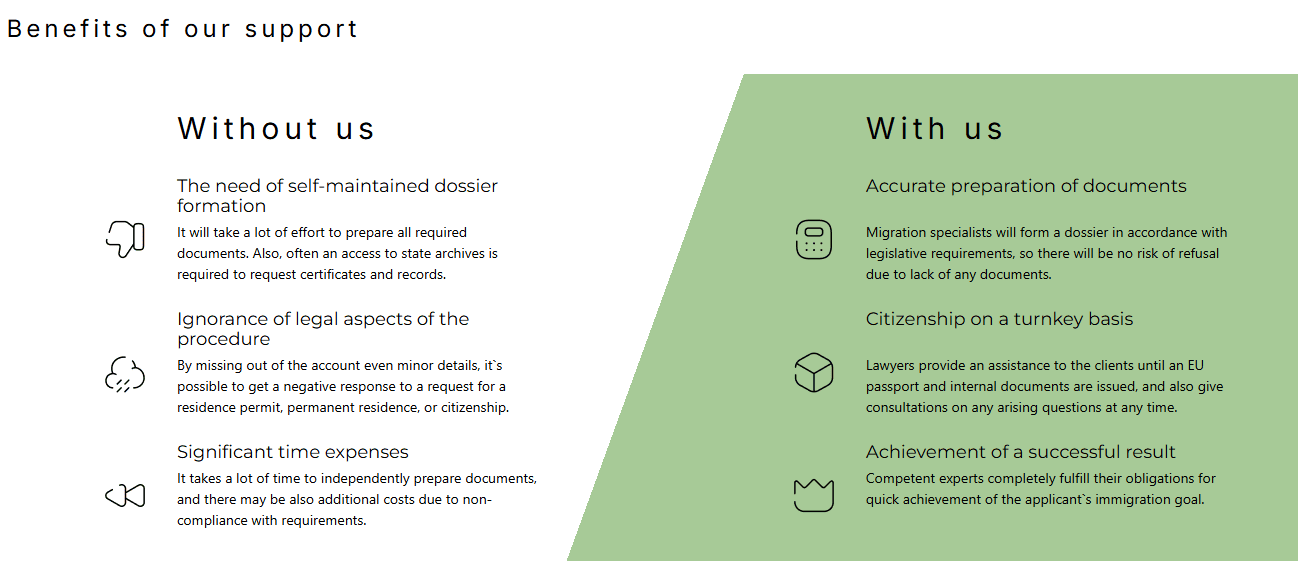
The exact scope of assistance depends on the applicant’s situation and the services agreed upon with the company. In practice, work may include:
- preliminary analysis of the citizenship route;
- assessment of existing records;
- identification of missing evidence;
- archive searches and requests for records;
- translation and formal document preparation;
- coordination of family applications;
- preparation of the application dossier;
- explanation of procedural requirements;
- guidance before stages requiring personal attendance.
Legallypass therefore treats the different stages as parts of one case rather than as unrelated administrative tasks. This is useful when an issue discovered during the documentary review affects work that has to be completed later.
The applicant still retains responsibility for providing accurate personal information, submitting available records and participating in procedures that cannot legally be delegated.
What Legallypass Reviews Can Tell Prospective Clients
For a better understanding of how the service works in practice, immigrants should check Legallypass reviews and compare the experiences described by previous applicants with the type of assistance they currently need.
Reviews are most informative when they describe how a company actually handled a case. General statements about satisfaction provide relatively little practical information. Details about document requirements, communication with lawyers, archive searches, family files or preparation for an official appointment are considerably more useful.
Available Legallypass.com reviews include references to assistance with family documentation and preparation before formal citizenship procedures. Such feedback can help people to understand how the legal team communicates, coordinates documentation between family members and prepares applicants for official appointments.
For this reason, it is more useful to evaluate reviews according to specific service-related factors:
- Were the documentary requirements explained clearly?
- Did specialists identify missing records?
- Was communication consistent throughout the case?
- Was assistance provided with difficult or archival documentation?
- Were family applications coordinated effectively?
- Was the applicant prepared for procedures requiring personal participation?
These questions provide a more objective picture of the service than the outcome of an individual citizenship case.
Legallypass.com Reviews and the Practical Value of Legal Assistance
The value of professional assistance becomes most visible in cases that cannot be completed using a straightforward set of current documents. Missing historical records, inconsistencies in civil status documents and applications involving several generations can significantly increase the amount of preparation required.
Legallypass.com provides a framework in which document collection, verification, formal preparation and procedural guidance can be coordinated as one process. Instead of independently determining which authority holds a missing record or how different documents should be connected, the applicant receives legal and documentary support within the same case.
When assessing Legallypass.com reviews, it is therefore reasonable to focus on aspects that can actually be controlled by the service provider: the quality of the preliminary analysis, work with documentation, communication, archive research, coordination of related applications and preparation for official procedures.
Legallypass cannot determine the decision of a national authority. Its role is to prepare the case so that the applicant approaches the relevant procedure with a structured documentary file and a clear understanding of the steps that remain.
Conclusion
The value of professional citizenship assistance is ultimately measured by how clearly and consistently a case is prepared for submission. Legallypass focuses on reducing procedural uncertainty, identifying documentary weaknesses before they become obstacles, and helping applicants approach the process with a properly structured case. Client feedback, including Legallypass reviews, can provide additional context on the quality of this work, while the final citizenship decision always remains with the competent national authority.